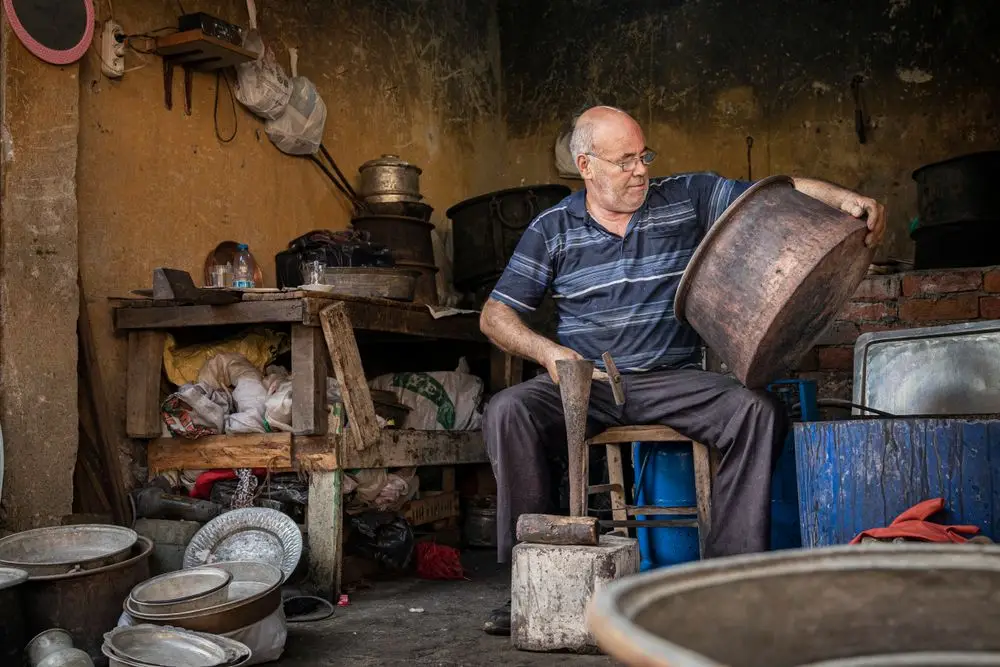
Somewhere back in your family tree, a real person spent their entire working life bent over an anvil, a loom, or a barrel of ale, and the job stuck to their name so completely that it outlived them by seven or eight centuries.
If your last name is Smith, Miller, Taylor, or Cooper, that is not a coincidence and it is not a family legend somebody made up. It is a literal job title, passed down through roughly thirty generations, still sitting on your mailbox today.
Occupational surnames are one of the clearest windows we have into what medieval life actually looked like. They tell you what people did for work, how much status that work carried, and sometimes even what a village needed most from the people who lived there.
This post walks through where these names came from, what dozens of them actually meant, and how to think about the occupational surname sitting in your own family tree right now.
Where Occupational Surnames Actually Came From
For most of medieval history, people in small communities got by with a single name. In a village of eighty people, there was rarely more than one person named Edwin or Alice, so a first name alone did the job.
That started to break down as populations grew and record keeping became a bigger part of daily life. Tax collectors, court clerks, and church officials all needed a reliable way to tell one Edwin apart from another Edwin living two farms over.
The fix was simple. People started adding a second identifier onto their given name, and that identifier usually came from one of four places. It came from where they lived, who their father was, some physical trait or habit people noticed about them, or the work they did every day.
Occupational identifiers were especially useful because they were public information. Everyone in a village already knew who the miller was and who the smith was, so using that word as a name required no explanation at all.
In England, this shift picked up speed after the Norman Conquest in 1066 and was largely locked into place by the time of national tax and population records in the late 1300s. Names that started as a description of someone's job slowly stopped changing when that person's children took up different work. The label just stayed, and it became a surname in the modern sense, something inherited rather than earned.
The Common Trades You Already Recognize
Some occupational surnames are so common today that most people who carry them have never once thought about what the word originally meant.
Smith comes from blacksmith, and it remains one of the most common surnames in the English speaking world for a simple reason. Nearly every village needed one. A smith made and repaired tools, horseshoes, nails, and weapons, which made the role essential to daily survival rather than a luxury trade.
Taylor comes directly from tailor, someone who cut and sewed clothing. Cooper made barrels and casks, a trade that mattered enormously in a world that stored and shipped almost everything in wood, from ale to salted fish. Baker is exactly what it sounds like, and its feminine form, Baxter, comes from an Old English word for a woman who baked bread professionally.
Weaver made cloth on a loom, and the feminine version of that trade produced the surname Webster. Mason cut and laid stone, a skilled trade tied closely to the building of churches, castles, and city walls. Carpenter worked wood into structures rather than furniture or small goods, which was its own separate trade from a wright.
The Names That Point to Status and Power
Not every occupational surname describes someone with dirt under their fingernails. Some point straight to positions of real authority inside a medieval household or estate.
Steward, and its Scottish form Stewart, described the person who managed a lord's household, land, and finances. It was such a position of trust and influence that the royal House of Stuart in Scotland took its name directly from the title. Chamberlain described a similar role, someone who ran the private household of a noble and controlled access to them, which made the position genuinely powerful despite technically being a servant's job.
Marshall started out even humbler, describing someone who cared for horses, and slowly climbed the social ladder until it became a formal military and court rank across much of medieval Europe. Bailiff described an official who managed a lord's land and collected dues from tenants on his behalf, a role with real local authority attached to it.
Forester, which also survives as Foster, described someone responsible for managing a lord's woodland, including enforcing strict hunting laws that could carry serious penalties for ordinary people. Falconer trained and managed hunting birds for a noble household, a specialized skill tied closely to the leisure of the wealthy rather than the survival needs of ordinary villagers.
The Miller's Complicated Reputation
Miller deserves its own section, because it sits in an odd spot between everyday trade and quiet local power.
A medieval mill was often owned by the lord of the manor, and villagers were frequently required by law to bring their grain there rather than grinding it themselves at home. That gave the miller enormous practical control over something every single household needed.
Millers typically kept a portion of the flour as payment for their service, a fee known as multure. That arrangement gave rise to a lasting stereotype across medieval literature that millers took more than their fair share, a suspicion that shows up in sources as old as Chaucer's Canterbury Tales.
Whether any individual miller actually cheated his neighbors is impossible to know this far removed. What survives clearly in the historical record is the tension. A trade that was economically essential also carried a reputation problem, and the surname carries a small trace of that history along with it.
The Trades Most People Have Never Heard Of
This is where surname history gets genuinely interesting, because plenty of occupational names describe jobs that vanished from daily life centuries ago.
Fletcher made arrows, specifically the feathered fletching that made an arrow fly straight, a trade with obvious and constant demand in a world where warfare and hunting both depended on archery. Wainwright built wagons and carts, combining the Old English word for wagon with wright, a general term for a skilled maker or builder.
Wright itself shows up as the root of several other surnames, including Cartwright, who built carts, and Shipwright, who built ships. Lorimer made the metal bits, spurs, and other small fittings used on horse tack, a specialized trade tied closely to any household that kept horses for travel or war.
Fuller, Walker, and Tucker all describe the exact same job in different regions of medieval England, someone who cleaned and thickened woven cloth by pounding and treading it, often in a mixture of water and clay. The trade was identical from village to village. Only the local dialect changed which word stuck as the surname.
Chandler made and sold candles, an item every household needed and few people wanted to make themselves. Naylor made nails by hand, one at a time, before industrial manufacturing made the trade obsolete. Collier mined or sold coal, and in some regions specifically described someone who burned wood into charcoal. Cutler made knives and other cutting tools, Currier finished tanned leather to make it usable, and Slater and Thatcher both describe roofers who specialized in one particular material.
Occupational Surnames Outside England
This pattern was not unique to England. Nearly every European language developed its own set of occupational surnames, often describing the exact same trades that produced Smith, Miller, and Taylor in English.
In German, Schmidt means smith, Muller means miller, and Schneider means tailor, and all three rank among the most common surnames in German speaking countries today for the same reason they do in English. In French, Fournier and Boulanger both describe a baker, Meunier means miller, and Charpentier means carpenter.
In Italian, Ferrari comes from the word for blacksmith or ironworker, and Sarti means tailor. In Spanish, Herrero means blacksmith. In Polish, Kowalski derives from kowal, the word for smith, making it one of the most common surnames in Poland.
If your family history runs through more than one country, it is worth checking whether a surname that looks unrelated to any English trade word is actually an occupational name in a different language entirely.
Why Your Surname Might Not Match Your Ancestor's Real Job
Here is the detail that trips up a lot of people researching their own family history. An occupational surname tells you what one specific ancestor did for work at the moment the name became fixed. It does not mean every generation after that continued in the same trade.
By the 1400s in England, surnames had mostly stopped changing to reflect a person's current occupation. A family named Smith might have produced farmers, merchants, and soldiers for the next twenty generations, all while keeping a surname that described a job none of them ever performed.
Spelling adds another layer of complication. Surnames were not standardized for centuries, and local clerks often wrote down names phonetically based on how they sounded rather than any fixed spelling. That is how you end up with Smith, Smyth, and Smythe describing the same family line across different records.
It also helps to know that not every name that looks occupational actually is one. Walker sounds like it should simply describe someone who walked a lot, but in most cases it points back to the cloth fulling trade described earlier. When you are researching a specific surname, it is worth checking more than one source rather than assuming the first explanation you find is correct.
What Your Surname Is Actually Telling You
An occupational surname is one of the few pieces of family history that survived without anyone having to write it down on purpose. Nobody sat down eight hundred years ago and decided to preserve this detail for their descendants. The name just kept getting used, generation after generation, until it hardened into a fact.
That is worth sitting with for a moment. A surname that started as somebody's job title is still, after seven hundred years, doing the one thing a name is supposed to do. It is telling you who someone was.
Most of the rest of that person's life did not survive the same way. We know the miller existed. We rarely know what he worried about, who he loved, or what he was proud of. The stories that would have answered those questions needed someone to ask them while there was still time, and in most families, nobody did.
That is the piece Memoracy was built for, not for the ancestors whose names are the only thing left of them, but for the people in your family right now whose stories can still be asked for, one simple prompt at a time.
Sign up and start your first story on Memoracy today.